
Read McPherson County Deeds
Every McPherson County deed records entry starts with one instrument. That paper moved an interest in land, and the Register of Deedes recorded it. Deeds name the parties and describe the parcel. Mortgages, releases, easements, plats, liens, leases, and affidavits often follow the same deed trail. The recorded type hints at what happened. But the words of the instrument itself control.
| Deed Type | What It Does | Common Use |
|---|---|---|
| Warranty deed | Conveys title with stated warranties | Ordinary arm's-length transfer |
| Quitclaim deed | Conveys whatever interest the grantor has | Family or title-cleanup transfer |
| Executor or trustee deed | Conveys through an estate or trust role | Estate and trust administration |
| Sheriff's deed | Records a court or tax-sale conveyance | Judicial or county tax sale |
| Plat or easement | Defines lots or grants a limited land right | Subdivision, access, or utility rights |
A mortgage or lien is not a deed. It is an encumbrance, a claim tied to the land. Do not assume it ended. Look for its release or satisfaction in the deed records. McPherson County recording rules ask that mortgage releases and assignments cite the original names, the legal description, and the book and page. Oil and gas releases or assignments should cite the original lease data.
McPherson Register of Deeds
The McPherson County Register of Deeds sits at 117 N Maple, Courthouse, PO Box 86, McPherson, KS 67460. Hours run Monday through Friday, 8 a.m. to 5 p.m. The phone is 620-241-5050. The county calls this desk the keeper of local land instruments. The office publishes no online deed index. There is no stated coverage cutoff. No public image gate exists either. So a searcher must go to the source. Call and ask about a counter index. Ask about a public terminal, a name or legal-description search, image access, and copy options. Skip any commercial index that does not come from the county record.
Note: Bring the exact owner spelling, legal description, and any book/page or instrument reference to reduce counter search time.
McPherson Deed Filing Checks
A missing filing can be an intake problem rather than a lost deed. The county's Basic Requirements list what an instrument needs. It must bear original signatures. It must be notarized or acknowledged. It must also carry the right legal description and show each signer's typed or printed name. A deed also needs a Sales Validation Questionnaire. That rule bends only if a cited Kansas exception is typed on the deed itself.
The county may return an instrument for many reasons. An insufficient fee, no original signature, or no legal description will do it. Missing mortgage details, no notary seal or signature, land outside McPherson County, or a missing questionnaire will also trigger a return. When a known transaction is absent from the chain, ask the Register of Deeds. The office can show whether a corrected or refiled instrument appears later under new recording data. The official filing page spells out each local check applied before McPherson County deed records are accepted.
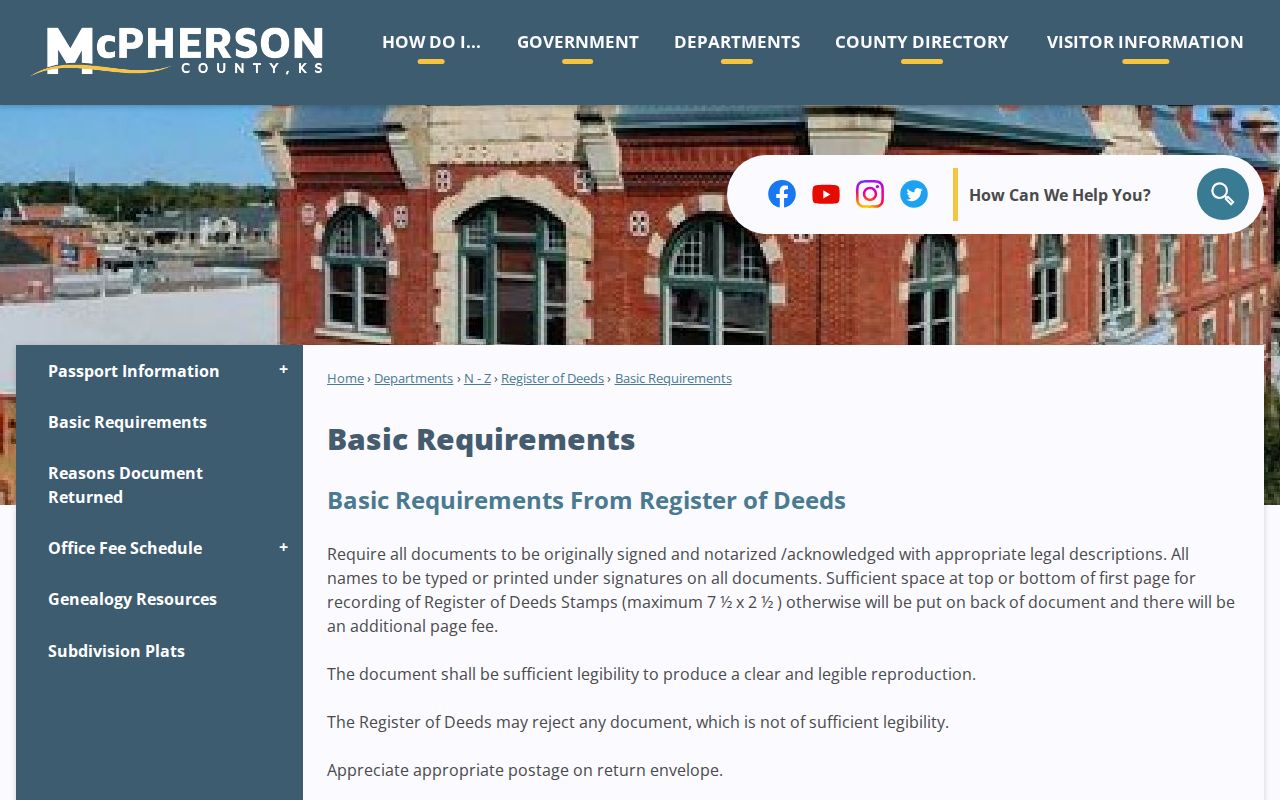
This explains why some signed private papers never get recorded.
Walk McPherson's Deed Chain
A grantor-grantee index runs by parties. The grantor gives the interest. A chain of title is the ordered run of recorded transfers for one parcel of land. Start from the latest known owner and legal description, then step backward one instrument at a time.
- Locate the current owner's acquisition deed with that owner as grantee.
- Read the grantor, legal description, deed type, and recording reference.
- Search that grantor as an earlier grantee and verify the same land.
- Repeat, checking plats, probate cases, and name variants when the chain breaks.
- Grantor
- The party transferring the interest.
- Grantee
- The party receiving the interest.
- Chain of title
- The linked sequence of instruments for the land.
- Book/page or instrument number
- The recorder's reference used to retrieve one filing.
Match the legal description at every step. A shared surname alone proves nothing. When the index trail goes cold, try initials, punctuation, married names, trustee wording, LLC suffixes, and "et al."; for the wider address-to-parcel method, use the McPherson County property search.
McPherson Deeds Since 1870
McPherson County's deed history runs deep. County genealogy material dates deeds, mortgages, and miscellaneous land records to 1870. The Kansas State Archives holds a McPherson County microfilm group covering 1870 through 2002. Deeds, courts, the county clerk, the treasurer, tax rolls, estate administration, and land ownership all appear in it. Plan on a research room or a records request.
The McPherson Public Library's McPherson Room adds more. County newspapers run from 1872 to the present. Directories and yearbooks date from the early 1900s. Photographs, maps, and atlases from 1884, 1887, 1921, and 1969 round out the collection. These sources explain an old address, business name, estate notice, or subdivision when deed books use terms absent from a modern map.
Search this trail in layers. Start with the current parcel. Its legal description anchors every step. Next, work the county deed books or grantor index back to the oldest clear reference, then carry that date, party name, and subdivision or township to the microfilm finding aid. Newspaper legal notices may reveal an estate auction, tax proceeding, plat filing, or road-name change near a transfer. An atlas shows the landowner or plat as it stood then, but it is a historical clue, not a substitute for the recorded instrument.
No fire or flood destroyed the core land books. A stalled web search proves nothing. The likelier obstacle is the split between portal data, local deed books, and the Archives microfilm run. Ask the Register which index series applies. The right book bridges any date in question.
Legal Descriptions in McPherson Deeds
A McPherson County deed rarely leads with the street address. Urban deeds describe an addition or subdivision, block, and lot. Rural deeds lean on quarter calls, section, township, range, and tract language. The plat turns a lot-and-block call into a mapped layout. Addresses can lag, change, or simply go unrecorded. So carry the full legal description from the assessor or tax result straight to the deed office.
The crosswalk between plat and parcel is not fixed. Replats, lot splits, combinations, vacations, and annexations all reshape it over time. When a parcel will not match, search under both the old and new plat names. The Register of Deeds holds the recorded plats and easements. Mapping can help with survey copies. A parcel line drawn on GIS stays reference data, never legal proof of a boundary.
Estate Deeds in McPherson
An estate can break a clean buyer-to-seller chain in McPherson County. Executor deeds, trustee deeds, determinations of descent, probate orders, affidavits, and corrective instruments all show how a parcel actually passed. Some estate records never made it online. Ask at the courthouse terminal or the clerk's window. Search the Kansas District Court Public Access Portal for a linked probate matter.
The court file gives context; the recorded land instrument supplies the deed-chain link. Death certificates are not open property indexes. Kansas limits who may obtain certified vital records. Archived newspapers can help too. Estate-sale notices and publication dates often narrow both the deed and probate searches.
McPherson Deeds and Encumbrances
Due diligence reaches past the ownership deed. The land record carries mortgages, assignments, releases, mechanic's liens, judgment liens, and tax liens. It also holds easements, rights-of-way, covenants, oil and gas instruments, and lis pendens. A lis pendens is a recorded notice that a lawsuit may involve the property.
A newer owner name proves nothing about an older burden. Find the release, satisfaction, termination, vacation, or court disposition that closed it. Some judgment liens live in two places: the District Court record and a recorded filing. The county's own tax-sale materials warn that a sheriff's deed carries no county title evidence. It also carries no warranty of marketable title.
Mortgage assignments and releases reward a careful name and reference check. McPherson County filing rules require a release or assignment to name the original mortgage parties. The rules also require the legal description and the book and page. That reference cleanly pairs a later release with the burden it ends. Oil and gas records work the same way. A later assignment or release should point back to the recorded lease. When the reference is missing or mismatched, pull both images. Compare the land descriptions before concluding anything.
Order McPherson Deed Copies
To order a copy from the Register of Deeds, request either an informational or certified version. Give the office the party names, the legal description, the date range, and any recording reference you have. The county posts an official fee schedule. It does not lay out a simple per-page price for deed copies. Before sending money, confirm the current charge, the page count, and any certification fee. Also confirm the accepted payment method and your return-mail needs.
No online index or image? The courthouse counter, phone, and mail all work. A narrow request can also go through the county's KORA process. County guidance says most requests are filled within three business days or receive an explanation. Reproduction and staff-time costs may apply under K.S.A. 45-219.
Recorded, not guaranteed. McPherson County deed records show accepted filings. They do not resolve every defect, priority issue, or unrecorded interest and are not a title opinion.