
Read McPherson Property Tax Records
Two offices split the work behind McPherson County property tax records. The Appraiser sets the value. The office also keeps the property data supporting it. The Treasurer bills, collects, and distributes the tax. A result bundles the parcel, a value year, the levy, charges, and payment history. It is not a sale-price statement or proof of title.
| Field | What It Shows | Where |
|---|---|---|
| Appraised value | County estimate of actual value for the year | Appraiser record |
| Assessed value | Taxable value after Kansas class rules | Appraiser and tax statement |
| Mill levy | Rate applied across the listed tax units | Detailed statement |
| General tax and specials | Ordinary levy plus parcel-specific charges | Treasurer tax history |
| Receipts and balance | Paid amounts, dates, interest, fees, and sum due | Treasurer result |
Kansas taxes only a share of a property's worth. Appraised value reflects fair market value, while assessed value is the taxable share set by assessment class and rate. Agricultural land may follow a use-value method instead. The mill levy states the tax rate in mills, and special assessments are separate charges; for a deeper treatment of these terms, see the McPherson County property value page.
McPherson Tax Module Fields
The CIC Tax Information Module is the county's main public tax lookup. It handles real estate and other tax types. Search fields include the grouped CAMA number, owner or taxpayer name, tax-year range, Tax Identification, street and ZIP, subdivision, block, lot, section, township, range, lease name, and Quick Ref. Filters narrow it further. They can limit results to current taxes. Or they show statements with current or delinquent sums due.
| Search route | Fields to enter | Result use |
|---|---|---|
| Known site | Street number, street name, ZIP | Locate the parcel and current bill |
| Known party | Name plus Current Owner, Taxpayer, or Both | Separate ownership lead from bill handling |
| Known parcel | CAMA segments, Tax ID, or Quick Ref | Exact tax-history match |
| Urban legal | Subdivision, block, lot | Search an addition or plat block |
| Rural legal | Section, township, range | Find land with weak address data |
The official tax form is dense but precise.
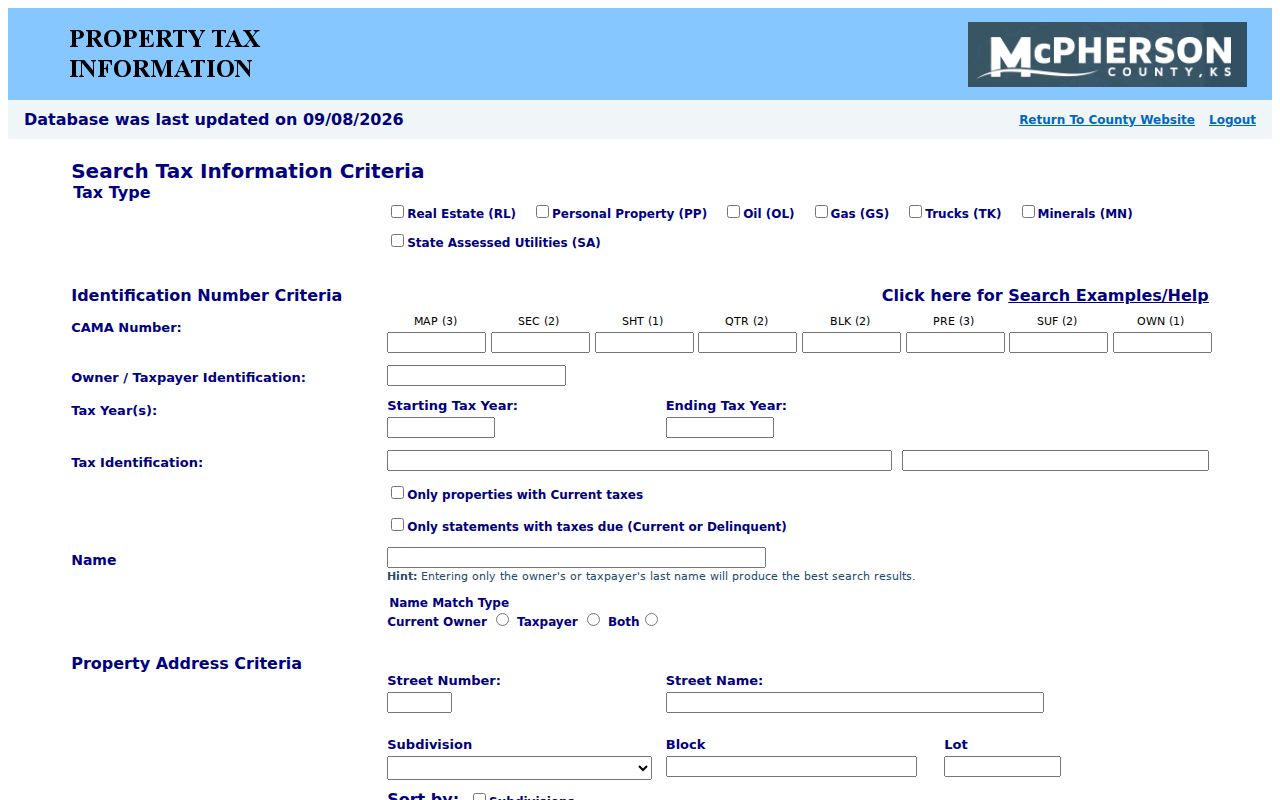
Those fields let a single query move from an address to a parcel key. From there, prior tax years open up.
McPherson Tax Statement Detail
A returned record can carry a lot. Expect tax type, grouped CAMA number, Tax Identification, owner and taxpayer IDs, situs, ZIP, subdivision, block, lot, section, township, range, tract, statement number, year rows, specials, payoff, installment sums, totals due, amounts paid, and a current-detail link. The detail view adds more. It shows Total Assessed Value, Total Mill Levy, General Tax, Specials, Total Tax, receipts, interest, fees, and a district chart. Locate the parcel first. Then open the tax-history result view.
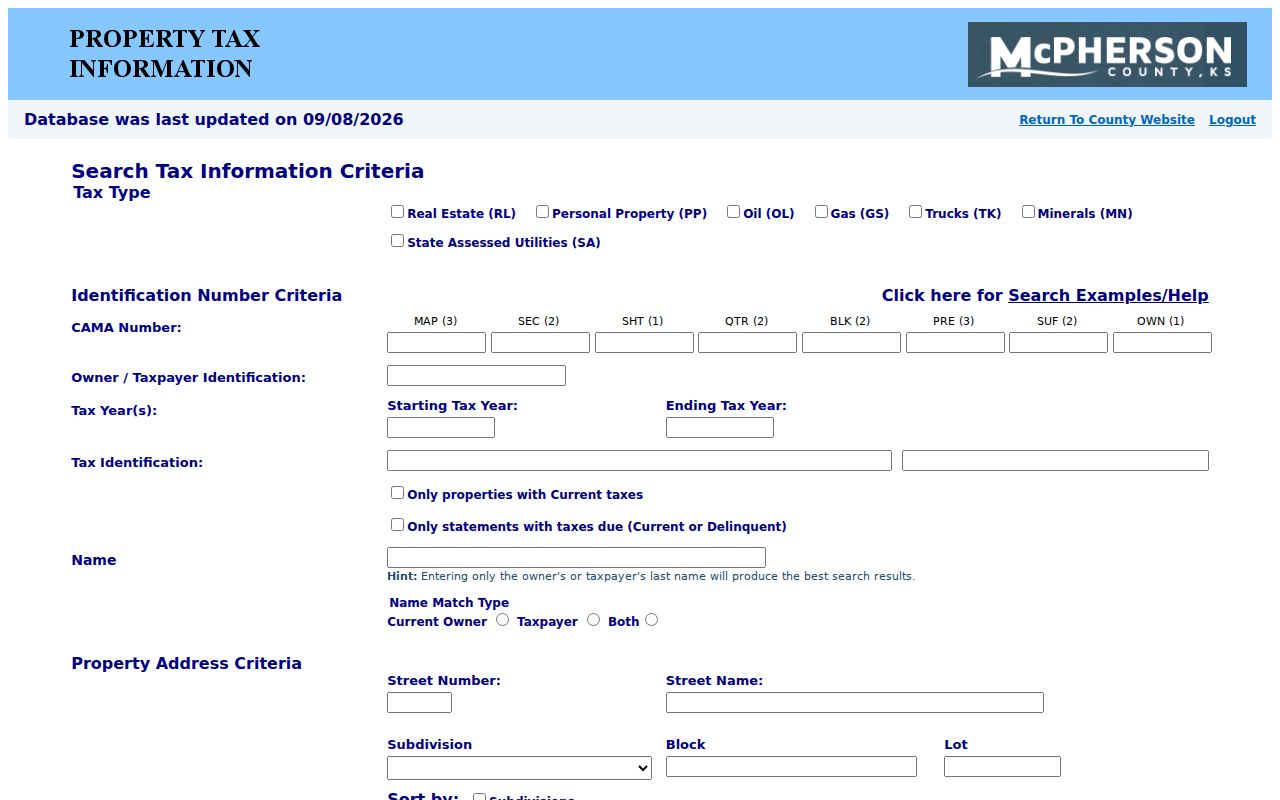
The history view keeps year, parcel, charge, and receipt fields side by side. A current balance stands apart from a prior paid bill.
Note: A paid receipt proves the account was credited, not which person supplied the payment funds.
Find a McPherson Tax Bill
Start with the strongest key you have. Use the result to pull the rest. Once found, the CAMA number and Quick Ref beat a broad name search every time. Check both a current bill and a historical row before deciding that tax is due or paid.
- Search by street address, CAMA, Tax ID, Quick Ref, or legal fields.
- Open the matching parcel and verify owner, situs, and legal description.
- Read the current statement, then compare prior tax-year rows and receipts.
- Call the Treasurer for a delinquent payoff or a status that is not clear online.
- Assessed value
- The taxable value produced under Kansas classification rules.
- Mill levy
- The combined tax rate applied by the listed taxing units.
- Special assessment
- A charge tied to a service or improvement for the parcel.
- Tax lien
- The government's claim arising from unpaid tax.
McPherson Tax Due Dates
The Treasurer mails tax statements by December 15. First-half real estate tax is due December 20. No reminder goes out for the second half. Through May 10 the first half can still be paid with interest; after that date, the full tax plus interest is due. Those deadlines make the online status and the Treasurer's current payoff figure matter most near a due date.
Delinquent tax is different. The county's ordinary online payment application cannot accept it. Call or write the McPherson County Treasurer at 620-241-3664 for a payoff. The office sits at 200 N Maple Street, Suite 100, McPherson, and lists weekday hours from 8 a.m. to 5 p.m.
A corrected value also changes the bill's path. The Appraiser originates the correction. The Treasurer then issues the corrected statement. If the first half was paid, a lower value may shrink the second half, and a fully paid year may bring a refund. Keep the old statement until the correction appears in the tax history, and ask which balance controls before a deadline-day payment.
McPherson Tax District Layers
A McPherson County tax statement can stack many units. County, city, township, school, library, cemetery, recreation, landfill, and fire districts may all share one levy. The district chart on the detailed statement explains why neighbors can owe at different rates, even when mailing addresses match, because city lines and township edges matter.
Use the county Mapping office and Kansas ORKA for district context. GIS boundaries are reference lines and may change. The tax statement still governs. Rely on it, and on any corrected statement, for the parcel's actual levy in a stated year.
Compare tax-unit lists before comparing two bills. A lower appraised value can still yield a different total across school, city, township, fire, or special districts. The levy chart explains the rate mix. It does not change appraised value itself.
McPherson Delinquent Tax Records
The county's delinquent real estate tax archive spans publications from 2007 through 2023. Each publication can list tax year, owner, tax unit, parcel, clerk legal description, amount, and publication timing. A publication is notice of tax status. It is not proof the property later sold.
County guidance says real estate unpaid for three years may face foreclosure suit and public auction. The current tax foreclosure sale instructions cite K.S.A. 79-2801 et seq. The county gives no abstract or title commitment. No marketable-title warranty either. A purchaser receives a sheriff's deed, though independent title review is still needed.
Appeal a McPherson Assessment
The 2026 McPherson County Appraiser notice says valuation notices were mailed March 1 with a 30-day appeal window. Scheduling could be online, in person, or by phone. An informal meeting begins the process. Further review can proceed through the Kansas Board of Tax Appeals route described by the county. Always use the date printed on the current notice rather than assuming a past year's calendar applies.
Before the meeting, request a Property Record Card and a comparable-sales sheet from the Appraiser's appeal-preparation resources. The PRC can show bedrooms, baths, square footage, and other characteristics. A comparable sheet can include the subject and up to five similar homes with prices and adjustments. Correct factual errors first, then support the value issue with relevant sales or property facts.
The Appraiser says residential property is valued as of January 1 and that market transactions drive the estimate. Staff draw from deeds, subdivision maps, building permits, contractor information, field inspections, measurements, construction type, costs, rental data, and verified sales. That source mix points to useful appeal evidence: a wrong building fact, a sale that is not comparable, a condition issue documented near the valuation date, or a legal-description mismatch. The portal is informational, so request the office record when one of those facts is disputed.
Appeal window. The county states a 30-day period after the valuation notice. Check the current notice and contact the Appraiser at once so the filing date is not lost.
McPherson Payment Under Protest
Payment under protest is a separate route. It ties the challenge to paying the tax itself. The county posts a payment-under-protest form and instructions. Read the current form for filing dates, parcel fields, stated grounds, signature, and submission steps. Never file both routes on a guess. Ask the Appraiser or Treasurer which procedure fits the current stage.
The Appraiser originates any value correction. The Treasurer then issues a corrected statement. A reduction may shrink the second-half amount, the county says, or produce a refund when the full bill was already paid. Keep one file. The notice, appeal papers, corrected statement, and receipt all belong in it.
If online access fails, the county's broader Kansas Open Records Act request route can reach a specific, existing tax or appraisal record. State the parcel key, tax year, record type, and copy format. Most records arrive within three business days. Otherwise the county explains any delay or denial. Copying and staff-time costs may apply, and a narrow request keeps the search estimate small.