
Check the McPherson County Owner of Record
Start with the McPherson County Appraiser roll. Not every detail appears as an online field. When the full current record matters, request a Property Record Card from the office and save the identifiers that tie one name to one parcel.
| Owner name | Current administrative owner entry; confirm spelling and entity suffix |
|---|---|
| Mailing address | Destination for notices, which may be a PO Box or another city |
| Situs address | Physical location of the parcel |
| Parcel identifiers | CAMA, Tax Identification, or Quick Ref linking systems |
| Last sale | Date, price, or recording reference if supplied on the requested PRC |
| Legal description | Lot/block/subdivision or rural section-township-range clues |
The owner of record is not always the occupant. A relative or manager can occupy the parcel. Use the mailing address as a public contact clue for a legitimate parcel matter, but it proves neither residence nor who handles the day-to-day mail.
Verify the Present Name With the Appraiser
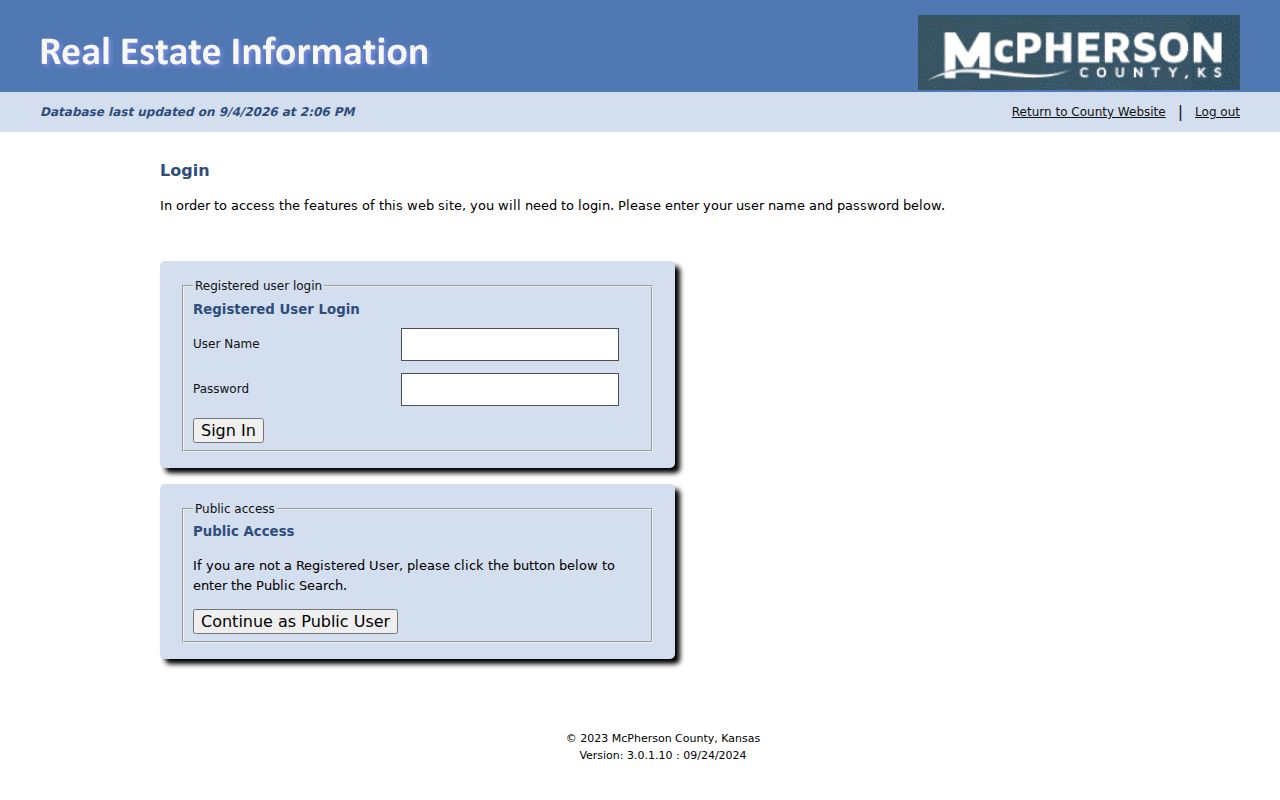
The McPherson County Appraiser Real Estate Portal is the county's public starting point for a current-owner check. The landing page separates public access from registered-user functions. Take the public route. Avoid assuming a precise set of online controls, since field layouts can change. For an authoritative fallback, contact the Appraiser at 200 N Maple Street, Suite 300, McPherson, 620-241-5870, or email appraisalrequest@mcpcoks.us.
Request the current Property Record Card and specify the parcel and CAMA number. Ask for the owner of record, mailing and situs addresses, classification, land and improvement values, characteristics, exemption flags, sketch, last-sale information, and any recording reference. Staff can pull all of it. The county labels its online data as informational. Take questionable data to the office directly.
Measure How Current the McPherson Owner Record Is
McPherson County updates property information annually at certification, with sales updating quarterly. The county publishes no universal closing-to-roll delay. No fixed deadline applies. Compare the roll's database date and sale information against the date of the newest recorded deed instead. That check shows the record's true age.
A recent sale can outrun the roll. The newest properly recorded deed may identify the current owner before the annual ownership roll reflects the closing.
Separate Current Owner From Taxpayer
The CIC Tax Information Module offers Name Match Type choices: Current Owner, Taxpayer, or Both. The distinction is useful. A lender, escrow company, tax service, or other payer can be linked to the tax statement. That party does not own the real estate. Tax results can include an Owner ID and name, Taxpayer ID and name, situs, ZIP, subdivision, block, lot, section-township-range, and tax history. Those fields anchor the owner name to the right parcel. They do not show who personally paid. The two names often differ for legitimate reasons. So treat the tax roll as a cross-check rather than proof.
Confirm the Current McPherson County Owner
Move from the live roll to the newest recorded deed.
- Find the parcel and copy the current owner exactly as the Appraiser or tax roll displays it.
- Carry the CAMA and legal description to the Register of Deeds; ask for the newest deed affecting that land.
- Compare grantee, execution and recording dates, legal description, and any trust, life-estate, or reserved-interest language.
- For an entity grantee, check its official Kansas business filing; for an estate, follow the relevant probate case.
- Use the public mailing address only for a lawful property-related communication.
- Owner of record
- The party named on the current administrative roll.
- Assessment roll
- The Appraiser's property listing used in annual valuation administration.
- Situs versus mailing
- The property location compared with the address receiving notices.
- Recording lag
- The interval between a deed reaching the land record and a related database updating.
Read the Newest Recorded Deed
The McPherson County Register of Deeds records land instruments at 117 N Maple, Courthouse, McPherson, phone 620-241-5050, with listed hours Monday through Friday, 8 a.m. to 5 p.m. The county offers no online deed index, so call or visit the Register for deed records. Check that the legal description matches the parcel. Read who the grantee is. Note how the deed states the interest. A deed can also reserve a life estate or convey through a trustee or executor. This step confirms the current transfer. Use previous owners only when the task grows into a backward chain.
Check a Present LLC, Trust, or Estate Owner
The Kansas Secretary of State Business Search accepts an entity name, state business ID, or current resident-agent name, and it returns only the first 200 matches. Match the exact entity from the deed and roll. A resident agent receives legal service, not beneficial ownership. Trusts need care. Note the trustee or trust name in the deed rather than assuming the mailing addressee owns individually. Estates can require two files. Combine the current recorded instrument with the District Court probate file. Kansas vital records are restricted, so rely on probate and recorded land records instead of a death-certificate lookup.
Cross-Check a Renamed McPherson Street
McPherson Ordinance 3454 renamed several roads in Barnstormer's West Field and Eastlinks and directed notice to the Register of Deeds and Appraiser. That creates a split trail. A search by the new address may pull up a deed or older tax entry under the former street wording. The land is the same. Do not assume the records disagree. Use the plat name, exact lot and block, and the section-township-range crosswalk to bridge the two. The address label changed; the parcel did not.
Ask the McPherson Offices for a Current Copy
If either portal is unavailable, request the Property Record Card from the Appraiser and the latest deed from the Register, asking about a public terminal and whether an ordinary or certified copy is needed. Request an itemized fee estimate too. The Register accepts office, phone, and mail routes. For anything not otherwise accessible, a narrow Kansas Open Records Act request serves as the fallback. County guidance sets a quick pace. Most requests produce records within three business days. Otherwise the county explains the delay or denial, and copying and staff-time costs can still apply.
Date every source you rely on. An Appraiser database reflects its own refresh date, every tax year brings new numbers, and a portal lookup speaks only for the moment you opened it. Check the execution and recording dates on the newest deed too. That dating habit makes any lag visible.
Hold the parcel identity steady. Save the CAMA segments, the Tax Identification, the Quick Ref, and the full legal description. CAMA labels can reconnect a record when spacing changes. Those labels are MAP, SEC, SHT, QTR, BLK, PRE, SUF, and OWN. For a city parcel, verify subdivision, block, and lot. For rural land, confirm section, township, and range instead.
Read the owner line letter for letter. Initials, punctuation, "et al.," trustee wording, and an LLC suffix all change how a name searches. Shared names call for a second test. Match the mailing address and the legal description before trusting a match. For an entity with name variants, compare the Kansas business ID and its status against the deed grantee.
The newest instrument may not be a simple sale. It could be an executor or trustee conveyance, a quitclaim, an estate affidavit, or a deed reserving an interest. A short index or roll line can leave out language that explains the present interest, so read the full document and its attachments.
Returned documents distort timing. McPherson County cites insufficient fees, absent original signatures, missing legal descriptions, incomplete mortgage data, missing notary signatures or seals, and missing Sales Validation Questionnaires as return reasons. A transaction may not be recorded yet. A corrected version may surface under later data.
The PRC ties the name to the right property. Appeal guidance says it lists bedrooms, baths, square footage, and other characteristics. If the physical description plainly fails to fit, recheck the parcel before relying on the mailing address or deed reference.
Tax status does not decide ownership either. A statement may show value, levy, general tax, specials, amounts paid, balances, fees, receipts, and districts. Those answer tax questions. They do not prove who paid, whether title is marketable, or whether another interest exists.
Use the McPherson Owner Mailing Address Carefully
A mailing address from McPherson records supports a letter about a boundary, a sale inquiry, an easement, an estate matter, or possible deed fraud. It is not the owner's residence. Kansas Safe at Home gives qualifying survivors a substitute address and first-class mail forwarding. Statutory confidentiality can justify redactions too.
Lawful use. One respectful property-related contact is different from surveillance or repeated unwanted contact. Never use current-owner information to stalk, harass, intimidate, or harm anyone.