
Identify Who Owns a McPherson County Property
McPherson County splits the ownership question across four offices. The Appraiser keeps the roll, the Treasurer handles tax bills, the Mapping office ties parcels to geography, and the Register of Deeds holds the recorded deed. Use each property records source for its actual role. No single screen is a complete ownership report.
- Enter the situs address in the McPherson County Appraiser Real Estate Portal or use Kansas ORKA to identify the parcel.
- Record owner of record, mailing and situs addresses, CAMA or Quick Ref, legal description, and any last-sale reference shown.
- Use the current owner or legal description at the Register of Deeds to identify the latest recorded transfer.
- If the grantee is an LLC, search the Kansas Secretary of State record; if it is a trust or estate, read the deed and related probate record.
- Use the roll's mailing address for a legitimate property communication, remembering that it does not prove residence.
Start With the Appraiser's Current Owner Field
McPherson County keeps its appraisal data in the CIC Appraiser Real Estate Portal, a public search tool for parcel and ownership details. Treat what it shows as a starting point. If an owner field, a parcel characteristic, or a sale reference looks off, the county advises verifying directly with the Appraiser. For anything that matters, request a Property Record Card from the office.
The Appraiser sits at 200 N Maple Street, third floor, Suite 300, in McPherson. Call 620-241-5870 or email appraisalrequest@mcpcoks.us. The office answers email within three business days.
Allow for McPherson County's Update Rhythm
The Appraiser updates property information once a year at certification and refreshes sales quarterly. That cadence sets no fixed gap. A closing and a new name on the roll can fall well apart. So a very recent deed can outrun the owner shown in the appraisal data. Compare recording dates when timing matters. Guessing from possession or a for-sale sign is a poorer guide. The deed records themselves are better. The portal's public entry screen displays the login page for real estate searches.
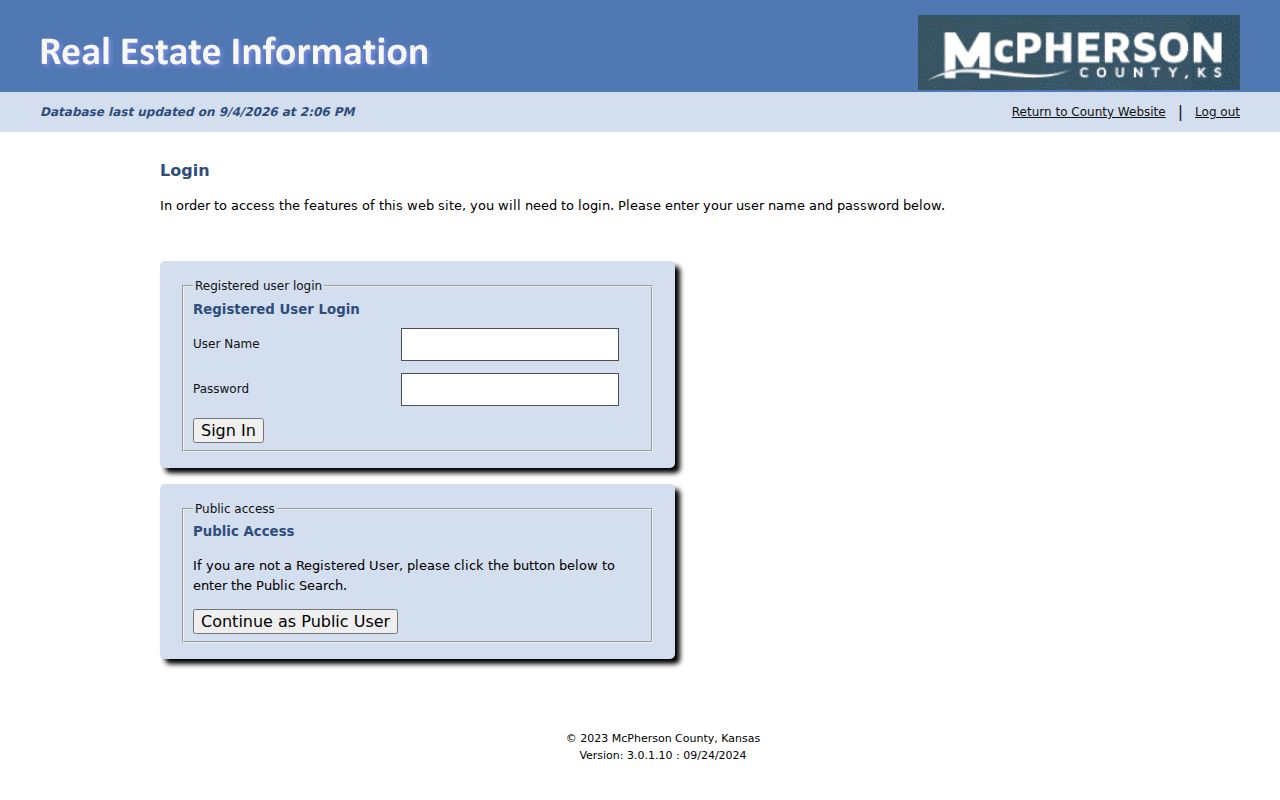
The login-style landing page still offers public access; registered-user functions are a separate matter.
Trace McPherson County Ownership to Its Source
No single record answers every meaning of the word owner. The tax roll locates a parcel and a name. The deed records the transfer that created ownership. The GIS map connects the name to actual ground. An entity filing may reveal the organization behind a grantee. Together, the McPherson County property records tell the whole story.
| Source | Owner Info It Gives | Access |
|---|---|---|
| Appraiser / tax roll | Current owner field, mailing and situs context | Public CIC portals; office PRC request |
| Register of Deeds | Grantee and vesting language in the latest recorded deed | Counter, phone, mail, or KORA; public index URL not located |
| Kansas Secretary of State | Business name, ID, status, resident agent and filing details | Official business search |
| Mapping / ORKA | Parcel selected by location and its identifying key | Public reference viewer |
Owner, taxpayer, and occupant can be three different people. The county tax search offers Current Owner, Taxpayer, or Both as name-match choices. A lender or tax service may handle the tax bill without owning anything. A tenant, relative, or caretaker may live on the land. They may never appear in the deed records. Knowing which role a name plays keeps a McPherson County property search clear. It avoids confusing paying with owning.
Use Current Owner, Not Taxpayer, as the First Cross-Check
The Tax Information Module takes a name and separates Current Owner from Taxpayer. It also searches street number and name. Searches cover ZIP, subdivision, block, lot, section, township, range, CAMA segments, Tax Identification, and Quick Ref too. That reach makes it handy when the appraisal portal stalls. A tax result can surface statement and payment details. But it cannot prove who paid, and its assessed value is not a sale price. Use it to reconnect an owner name to the right parcel. Use the deed records, not the tax bill, for ownership itself.
Confirm the Property Owner With the Latest Deed
The McPherson County Register of Deeds records every document that affects ownership of land. It also records documents that affect use of land in the county. Start from the county Register page, the office's official online home. It publishes no public deed-index URL. So parcel-number and deed records searches happen at the office itself. Call 620-241-5050 or visit 117 N Maple, Courthouse, PO Box 86, McPherson.
Ask for the most recent deed tied to the exact legal description. Then read the grantee line closely. Watch for vesting, reservation, life-estate, trustee, or estate language. That language changes who the true owner of record is. A deed floating around in private paperwork may never have been recorded. The cause could be a missing legal description, an absent original signature, a notary problem, an unpaid fee, or a missing Sales Validation Questionnaire. Confirm the recorder actually accepted it.
Decode LLC, Trust, and Estate Ownership
An LLC may be indexed with or without punctuation or its suffix. Retry the exact name and loose variants. The Kansas SOS search takes a business name, state business ID, or resident-agent name. It caps results at the first 200 matches. An agent is a service contact, not automatically the beneficial owner of the land. A trust may appear under the trust name or the trustee's. Estate transfers can require probate, a determination of descent, an executor's deed, or an affidavit. A recorded deed may point to a case. When it does, search the District Court portal and the courthouse terminal. Vital records are restricted, so they offer no shortcut to ownership. Kansas demands an eligible relationship or a direct property-right interest for certified copies.
Recover When the Address Does Not Search
A street address is less durable than a legal description. Try a shortened street string. Try an owner variant, subdivision and lot, section-township-range, or the parcel's Quick Ref. For rural land, section calls often beat the mailing city. Where city streets changed, compare plats and older county records. McPherson Ordinance 3454 renamed several streets in Barnstormer's West Field and Eastlinks. It directed the changes to be filed with the Register of Deeds and Appraiser. That crosswalk explains a lot. It shows why an older instrument and a current parcel can carry different road names in the McPherson County property records.
Distinguish Owner of Record From Title
- Owner of record
- The party named in the current administrative ownership roll.
- Grantee
- The party receiving an interest in a recorded deed.
- Title
- The legal ownership interest, which can involve matters beyond a name displayed in a database.
- Situs address
- The physical property address.
- Mailing address
- The address used for notices; it does not prove residence.
Use the Counter, Mail, and KORA Routes
When a portal lets you down, go around it. Call the right desk. Ask whether the office has a public-access terminal. Then follow up with a narrow written request. Under the Kansas Open Records Act county procedure, most requests produce records within three business days. Otherwise you receive a written explanation of any delay or denial. Copying, reproduction, and staff time may carry charges. Advance payment can be required.
For depth, the county's deed records reach back to 1870. A Kansas State Archives microfilm group covers the mortgages and miscellaneous land records from 1870 through 2002. The McPherson Public Library holds atlases, directories, and newspaper microfilm. These help when an address changed or a family name shifted. Still, the recorded transfer is the ownership evidence that counts.
Build an evidence log as you go. Track the portal used, the access date, owner spelling, parcel number, situs, mailing address, legal description, and recording data. When sources disagree, never pick one quietly. An update lag, a returned instrument, a renamed street, a parcel split, or an owner-versus-taxpayer distinction may explain the mismatch.
The legal description is your strongest safeguard across systems. Street names change and mail goes elsewhere. A subdivision lot and block, or a section-township-range reference, ties the GIS map, tax parcel, plat, and deed together even when an address fails. Keep both present and former parcel keys for any tract that was divided or combined.
Recorded documents can complicate a simple name search. Warranty, quitclaim, executor, and trustee deeds, or a determination of descent, each change how ownership appears in the property records. A life estate may give one party a present interest and another a future one. The tax roll often squeezes that nuance into a short line, so read the instrument itself.
Liens and mortgages are not ownership. The Register of Deeds records mortgages, assignments, releases, liens, easements, and covenants, while courts hold judgments, foreclosure, quiet-title, and probate files. A lender, secured party, or taxpayer name on a document does not make that party the owner of record.
Estates take matching. Align court and land records by decedent, case number, legal description, and recording reference. Kansas limits certified death records to eligible requesters, including a person proving a direct property-right interest. Public probate orders and recorded land instruments are the proper route. Do not try to bypass the restriction.
Older ownership questions need a longer look back. County deeds and mortgages run from 1870, and State Archives microfilm reaches to 2002. Library directories and newspapers help explain name or address changes but stay supporting clues. For direct contact, write one letter to the public mailing address. Explain the property matter plainly. Never infer residence or family ties from the owner name.
Know What “Who Owns This Property” Cannot Tell You
A public owner name answers only one question. It does not prove occupancy, reveal beneficial interests behind a trust, clear liens, or guarantee marketable title. Kansas Safe at Home supplies a substitute address and mail forwarding for qualifying survivors, and other confidentiality rules can limit personal details in the property records. Respect redactions rather than hunting for workarounds.
Not a title search. Use a property owner lookup for purchase diligence, boundary communication, estate research, or fraud prevention. Never use ownership information to stalk, harass, intimidate, or harm a person.